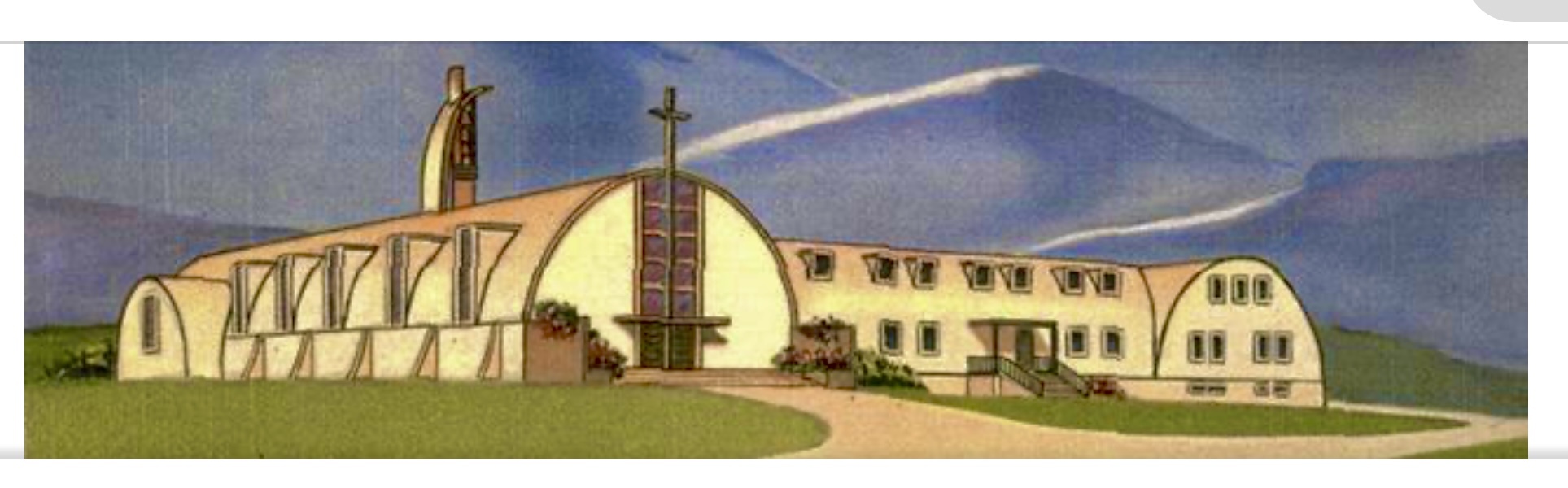

By Michael Patrick O’Brien–

I’ve seen death but not resurrection. The Easter notion of life beyond death mystifies me.
Church art helps my simple mind grasp this ethereal concept. And the lovely art at the Utah Catholic church I’ve attended for half of my life is especially evocative.
In 1985, the Utah Catholic bishop appointed Father Terry Moore as pastor of the fledgling St. Thomas More Parish in Cottonwood Heights. Moore was born in Ireland but came here soon after ordination.
He was a kind and devoted pastor. His first big task at St. Thomas More was to build a new church.
Moore hired architect Michael J. Stransky. From Wyoming and colorblind, Stransky took up his vocation because he loved to build things.
As a Cathedral of the Madeleine parishioner, Stransky understood traditional church architecture. But he and Moore yearned to do something different at St. Thomas More, nestled on the east bench between Big and Little Cottonwood canyons.
Moore told The Salt Lake Tribune in 1994 that he wanted parishioners to see the glorious mountains “from anywhere in the sanctuary.” He wanted “lots of light, natural materials and simplicity throughout.”
So Stransky created what he’s called a “celebration of light and the view and the place.” Legendary Tribune columnist Jack Goodman sketched the remarkable building for his column in August 1993, calling it “radical” and “a fresh architectural look.”
Moore and Stransky hired area artists and artisans for the interior features, including the altar, stained-glass windows and other decor.
The delicate chisel of woodworker Tom Tessman and the powerful hammer of noted Utah sculptor Neil Hadlock shaped two of those features.
The Minnesota-born Tessman’s work adorns other parts of Salt Lake City, too. He placed two dozen pavers on downtown’s Pierpont Avenue that say “heart” in 25 different languages.
Tessman’s obituary invokes “Anthem,” a song by musician Leonard Cohen: “There’s a crack in everything; that’s how the light gets in.”
There are many cracks in the huge wooden screen Tessman designed for the church sanctuary. Dozens of interlocking crosses form the intricate structure.
The gaps in between offer fleeting glimpses of the sacred tabernacle behind it. They also choreograph the colored beams of stained-glass light that stream in and dance around Hadlock’s formidable altar piece.
According to The Tribune, Hadlock sculpts with “weight, elegance.” Hailing from two generations of blacksmiths, the Idaho native taught at Brigham Young University and owned the metal foundry that made the Philo T. Farnsworth statue formerly in the U.S. Capitol.
Hadlock is known for “monumental abstract[s]” like “An Urban Allegory,” the stainless steel sculpture just outside the Delta Center. He’s said he wants his work “to stay close to the stuff of the earth: iron, bronze, stone, clay, graphite and pigment.”
That’s exactly what he did with the St. Thomas More altar and baptismal font. They look like Hadlock hammered them out of a nearby quarry and then hauled them right into the sacred space.
The altar’s flat surface rests on a trinity of rough-hewn pillars that blend with the church’s Rocky Mountain surroundings. When holy water trickles through Hadlock’s matching baptismal font some 50 feet away, I hear an alpine spring and waterfall.
For statues and stained glass, Moore and Stransky turned to Ursula Brodauf and Anna Campbell Bliss. Both were inspired choices.
The German Brodauf was from the Erzgebirge region, known for its wood carvers, toy makers, and folklore. She apprenticed under a master woodworker whose products remain popular even today.
Brodauf studied art in Berlin after World War II, emigrated to Salt Lake City, and worked as a ZCMI store window designer. Soon she evolved into “one of the 100 most-honored artists of Utah,” according to the Springville Museum of Art.
Brodauf created the Stations of the Cross that line St. Thomas More’s side walls. She also sculpted huge papier-mache and fiberglass statues of the Holy Spirit, Mary, and Jesus for the front.
These suspended images are colorful and folkloric. I liken them to supersized wood carvings steeped in Germanic myth, fantastic fable and even sacred magic.
Between them is a towering wall punctuated with 150 square stained-glass boxes, all designed by Bliss. She came to Utah in the 1960s with degrees in art and architecture from Wellesley and Harvard.
Leaving behind her place in a vibrant arts community, Bliss struggled to find her bearings here. She studied screen printing and computer programming.
Bliss also learned about movement and dance at Salt Lake City’s famed Repertory Dance Theatre. (RDT celebrates its 60th anniversary season this year.)
By 2012, according to The Tribune, Bliss was “one of Utah’s cutting-edge artists — passionately experimenting in color and spatial relationships, while probing the intersections of painting, math, language, dance and music.”
The newspaper also said “color and light” were the “prolific artist’s trademarks.” Her stained-glass art at St. Thomas More—which Bliss called “Light of Grace”—underscores that description.
Rather than depicting a saint or a Bible story, the windows soar geometrically up and across the wall. On sunny days, they electrify the sanctuary, providing a blissful glimpse of heaven.
I think Stransky and Hadlock are now well into their 80s. Brodauf died in 2011 and Tessman three years later. Bliss followed in 2015 and Moore died in 2023.
Despite their aging and passing, their art still flourishes. It’s a form of life after death that nourishes my spirit.
It is uplifting.
It raises me up.
And it dares me to hope that the Easter miracle of resurrection just might someday grace my mortal existence too.
*Mike O’Brien (author website here) is a writer and attorney living in Salt Lake City, Utah. Paraclete Press published his book Monastery Mornings, about growing up with the monks at the old Trappist monastery in Huntsville, Utah, in August 2021. The League of Utah Writers chose it as the best non-fiction book of 2022. Mike’s new holiday novel, tentatively titled “The Merry Matchmaker Monks,” will be published in time for Christmas 2026.
